

Caryatids, Parliament, Vienna, Austria
The Austrian Parliament Building deliberately echoes Ancient Greek architecture. Caryatids – Greek maidens devoted to the goddess Artemis – can be found holding up the Porch of the Erechtheion in Athen’s Acropolis.

Burgtheater, Vienna, Austria 1
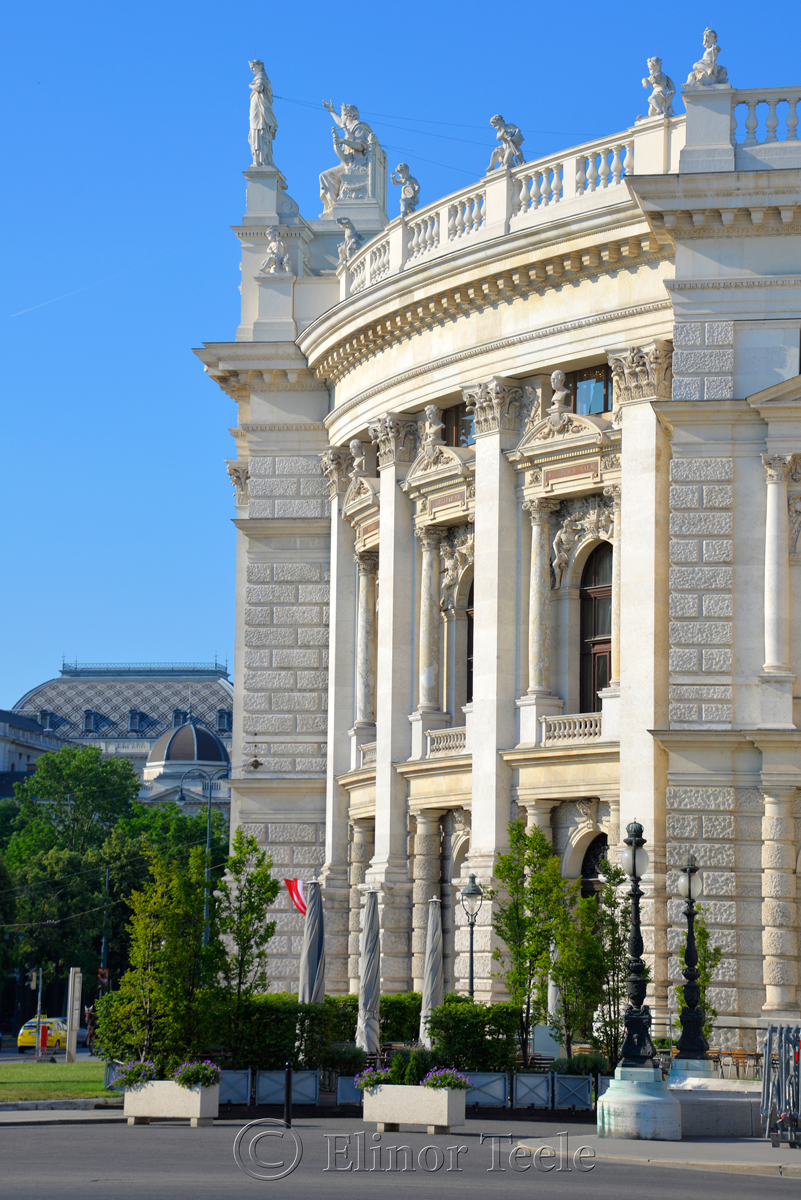
Vienna’s Burgtheater (“City Theater”) has experienced a peripatetic life. When it was first formed by Maria Theresa, in A.D. 1741, it was housed in the Imperial Palace. 10 years later, it moved to the Königliches Theater nächst der Burg (Royal Theatre near the Palace). This is where 3 of Mozart’s
Burgtheater, Vienna, Austria 2
In his 20th century memoir, The World of Yesterday, Stefan Zweig talks about his youthful obsession with this building: “For the Imperial theatre, the Burgtheater, was for the Viennese and for the Austrian more than a stage upon which actors enacted parts; it was the microcosm that mirrored the macrocosm,

Wächterin Sculpture, Burgtheater, Vienna, Austria 1
The Wächterin (“Guardian”) stands sentinel on the Ringstrasse, on the lawn in front of the Burgtheater. The vulture-like sculpture was created by the modern artist Ulrike Truger in A.D. 1988. Soon after she finished the work, a series of letter bombs hit Austria. People who spoke out for immigrants were
Continue readingWächterin Sculpture, Burgtheater, Vienna, Austria 1

Wächterin Sculpture, Burgtheater, Vienna, Austria 2
If you like the Wächterin, you can find Ulrike Truger’s work elsewhere in Vienna. Her abstract sculpture honoring Marcus Omofuma, a Nigerian asylum seeker who suffocated to death while protesting against his deportation, is on the Mariahilferstrasse. Her figure-based tribute to Empress Elisabeth, entitled “Elisabeth: coercion, escape, freedom,” is at
Continue readingWächterin Sculpture, Burgtheater, Vienna, Austria 2


Rathaus, Vienna, Austria
Just like similar projects in Paris, the Ringstrasse development in the 19th century completely transformed Vienna. Out came the medieval city walls and moats; in went the Staatsoper, the Burgtheater, parts of the Hofburg, the Parliament, and the neo-gothic Rathaus (“Town Hall”). Completed in A.D. 1883, Friedrich von Schmidt’s town

